Kingston's geology changes fast. In the old downtown grid around Sydenham Ward, the limestone bedrock sits shallow, sometimes just two meters down. Cross the Cataraqui River into the east end and you hit deep glaciolacustrine clay that can extend past twenty meters. That contrast changes everything for a foundation. A project on Ontario Street needs a different geotechnical approach than one on Highway 15. Our laboratory runs a full soil mechanics study that maps those transitions with grain-size curves, Atterberg limits, and triaxial shear data. We don't guess based on a map. We test. The glacial till across the city has variable boulder content and silt pockets that only lab work catches. When a developer needs bearing capacity and settlement numbers the city will approve, we deliver them. For deeper characterization, we often pair the lab program with CPT testing to get a continuous stratigraphic profile before sampling.
Kingston sits on a geological boundary where shallow limestone meets deep glacial clay. Testing both extremes in the same soil mechanics program avoids surprises during excavation.
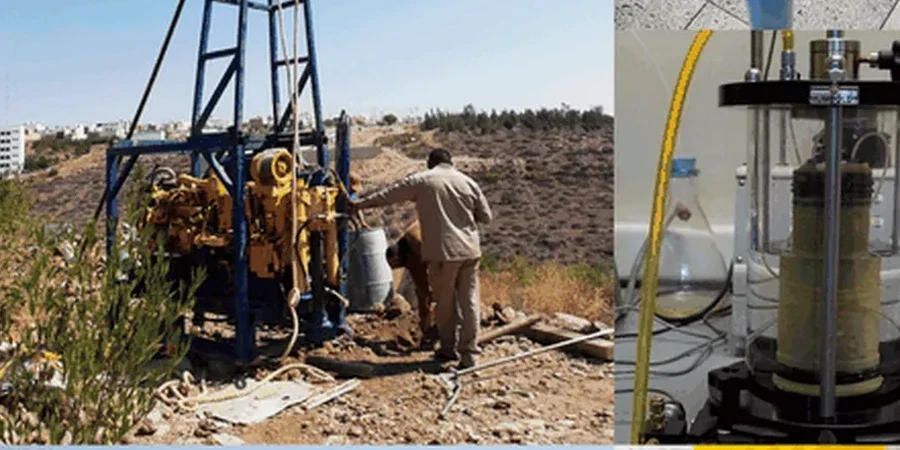
Our approach and scope
Site-specific factors
A twelve-story residential tower on Princess Street hit running sand at the fourth floor of the underground parking excavation. The contractor had assumed stiff clay based on a single borehole. The sand lens wasn't thick, but it was pressurized and started flowing into the cut. That job stopped for three weeks. Our soil mechanics study for that block had flagged the unit three months earlier from a detailed lab classification and triaxial permeability test. The developer chose to proceed with a cheaper investigation. The cost of the delay exceeded the original geotechnical budget by a factor of ten. In Kingston's layered glacial sequence, you cannot interpolate between boreholes without lab verification. A thin water-bearing silt seam can destabilize a shoring wall or cause base heave. We test every distinct stratum because the margin for error in a confined urban excavation is zero.
Regulatory framework
NBCC 2020 (National Building Code of Canada, seismic and foundation provisions), CSA A23.3:19 (Design of concrete structures, foundation requirements), ASTM D2435/D2435M-11 (One-dimensional consolidation properties of soils), ASTM D4767-11 (Consolidated undrained triaxial compression test), ASTM D6913-04(2009)e1 (Particle-size distribution gradation)
Related services
Lab Testing Suite
Grain-size analysis, Atterberg limits, triaxial (UU, CU, CD), direct shear, one-dimensional consolidation, and unconfined compression. All testing follows ASTM standards with chain-of-custody documentation.
Field Sampling and Logging
Shelby tube sampling in soft clay, split-spoon sampling in till, and rock coring with NQ or HQ barrels. We log moisture, density, and recovery at every run.
Bearing Capacity and Settlement
We calculate allowable bearing pressure for shallow footings and mat foundations using lab-derived shear strength and consolidation parameters, with settlement estimates over a 50-year design life.
Excavation Stability Review
For deep excavations in Kingston's mixed soil profile, we provide undrained shear strength profiles and pore pressure parameters to support shoring design and base stability checks.
Typical parameters
Common questions
How much does a soil mechanics study cost in Kingston?
For a typical residential or light commercial project in Kingston, the lab and field program ranges from CA$4,640 to CA$7,680. The final cost depends on the number of boreholes, sample quantity, and the specific tests required. A full suite with triaxial and consolidation testing sits at the upper end.
How long does the lab testing take?
Standard classification tests like grain-size and Atterberg limits take three to five business days. Consolidation and triaxial tests run longer, typically two to three weeks, because of the time needed for saturation and slow loading stages.
What's the biggest geotechnical risk in the Kingston area?
The abrupt transition from shallow limestone bedrock in the central peninsula to deep compressible clay east of the Cataraqui River. Underestimating the clay thickness leads to excessive settlement and costly foundation redesign.
Do you test for Leda clay sensitivity?
Yes. In areas like Collins Bay and along the waterfront where Leda clay is present, we run unconfined compression tests on undisturbed samples and measure the remolded strength. A sensitivity above eight triggers special excavation protocols.
What standards do you follow for a soil mechanics study?
Our lab operates under ISO 17025 accreditation and follows ASTM methods for all testing: D6913 for grain-size, D4318 for Atterberg limits, D2435 for consolidation, and D4767 for triaxial. Reports reference the NBCC 2020 where applicable.