Kingston sits on a complex foundation of marine Leda clay and glacial till that shifts beneath your feet when you cut into it. Crews working near the Cataraqui River or out toward Lake Ontario Park routinely encounter pockets of sensitive clay that lose strength the moment they're disturbed. Our geotechnical analysis for soft soil tunnels maps these transition zones before excavation begins, giving contractors a clear picture of where stand-up time shortens and where groundwater will push hardest against the lining. We draw on decades of regional borehole data—including the deep clay sequences documented by the Geological Survey of Canada along the Kingston waterfront—to calibrate deformation predictions that generic desk studies miss. The work ties directly into the National Building Code of Canada requirements for underground structures, and we pair site-specific lab programs with CPT testing when access conditions demand continuous profiling through the variable clay-silt interfaces common across the city's limestone plain.
Kingston's sensitive Leda clay can lose over eighty percent of its undisturbed strength after remolding—tunnel design here is a race against strain-softening, not just stand-up time.
Our approach and scope
Site-specific factors
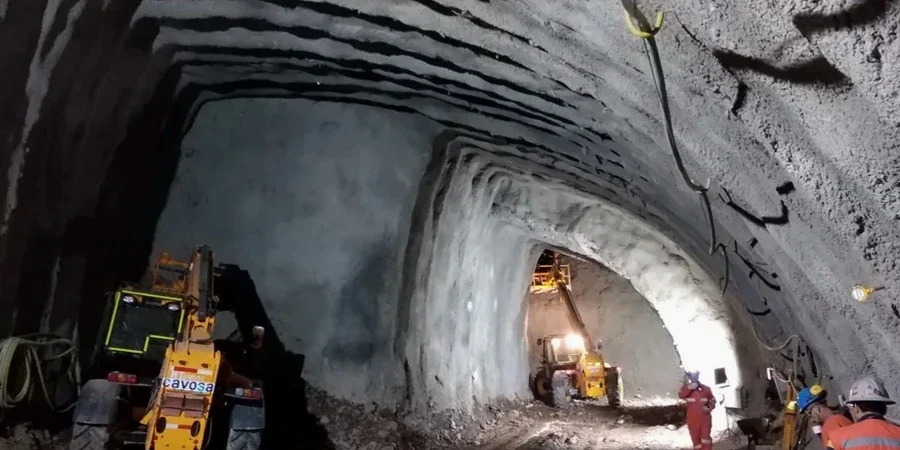
Our field team deploys a truck-mounted CPT rig with a 20-tonne push capacity directly onto the Kingston Limestone pavement, advancing the cone through the clay crust at a controlled rate of 2 cm/s to capture pore-pressure response in real time. The most dangerous assumption in this city is treating the Leda clay as a homogeneous mass. A tunnel face that stands unsupported for three hours in the desiccated upper crust can collapse within twenty minutes once it enters the intact, saturated zone below six metres—the same material, but a completely different risk profile. Face blowouts, crown instability driven by negative excess pore pressures during advance, and long-term consolidation settlement under adjacent heritage structures all demand analysis that goes beyond a single factor of safety. Our geotechnical analysis for soft soil tunnels quantifies these failure mechanisms separately, producing deformation contours that let the contractor pre-select the right sequence of breasting, spiling, or ground improvement. Where the tunnel alignment passes beneath operational rail corridors near the Kingston station, we also assess vibration-induced strength degradation using cyclic triaxial data referenced against Seed and Idriss-type triggering curves adapted to Eastern Canadian seismicity.
Regulatory framework
NBCC 2020 (National Building Code of Canada), CSA A23.3:19 (Design of Concrete Structures), CSA S6:19 (Canadian Highway Bridge Design Code, Section 7 – Foundations and Geotechnical Systems), ASTM D4767 (Consolidated-Undrained Triaxial Compression Test on Cohesive Soils)
Related services
Tunnel Alignment Geotechnical Assessment
Borehole planning, undisturbed sampling of Leda clay, laboratory strength and consolidation testing, and 2D finite-element or finite-difference deformation analysis calibrated to Kingston's overconsolidated clay profile. Includes face stability calculations for sequential excavation methods and lining pressure recommendations.
Groundwater and Consolidation Modeling
Three-dimensional seepage analysis using in-situ permeability test data, prediction of steady-state inflows, and time-rate consolidation settlement estimates beneath Kingston's historic limestone buildings adjacent to the alignment. Outputs feed directly into the dewatering permit application and the environmental compliance documentation.
Typical parameters
Common questions
How much does a geotechnical analysis for a soft soil tunnel in Kingston typically cost?
The fee depends on the length of the alignment, the number of boreholes required, and the complexity of the lab program. For a typical utility or pedestrian tunnel project in the Kingston area, the geotechnical analysis ranges between CA$5.600 and CA$19.690, covering field investigation, triaxial and consolidation testing, and the deformation modeling report.
What makes Kingston's Leda clay so sensitive for tunneling?
Leda clay was deposited in the post-glacial Champlain Sea and has a flocculated, card-house microstructure that gives it high sensitivity. When it is remolded during excavation, the structure collapses and the undrained shear strength can drop by an order of magnitude. In Kingston, the sensitivity values commonly exceed 30, which classifies the material as 'highly sensitive' and requires rapid lining installation to prevent progressive face failure.
Do you handle the borehole drilling and sampling in-house?
We coordinate all field operations, including hollow-stem auger drilling and thin-walled Shelby tube sampling, through our long-term Kingston-area drilling partners. Our geotechnical engineer logs every borehole, supervises sample extrusion, and manages the chain of custody to the laboratory, ensuring the undisturbed samples meet the requirements of ASTM D1587 for subsequent triaxial and consolidation testing.
Can you model the impact on historic buildings near the tunnel alignment?
Yes. We perform staged excavation simulations that calculate the ground settlement trough and the resulting angular distortion at existing foundations. For sensitive structures—like the limestone buildings in downtown Kingston—we compare the predicted distortion against the threshold values in the Canadian Foundation Engineering Manual and recommend compensation grouting or underpinning where the predicted movement exceeds acceptable limits.