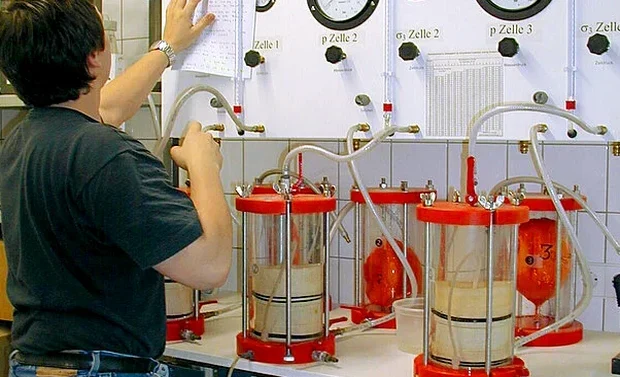
The CBR press in our Kingston lab runs a 50 kN load frame with a piston advancing at 1.27 mm per minute. We prepare remolded samples at Optimum Moisture Content, compact them in 152 mm diameter molds, and submerge them in water for 96 hours before penetration. Kingston’s subgrades are unpredictable: you hit stiff glacial till north of the 401, then soft Leda clay near the Cataraqui River floodplain. Standard Proctor compaction and a soaked CBR value tell us how much aggregate base you actually need. Without that number, you either overbuild and waste money on stone, or cut it thin and watch ruts form after two freeze-thaw cycles. We run the test per ASTM D1883, and we also do AASHTO T 193 when MTO jobs require it. For pavement jobs where subgrade variability is high, we often pair the lab CBR with a CPT test to map weak lenses across the alignment.
Soaked CBR below 3 percent means you need chemical stabilization or a thicker granular base — we see that in the Cataraqui lowlands.
Our approach and scope
Site-specific factors
Kingston's freeze-thaw cycle count averages 80 to 100 per winter. Water expands 9 percent on freezing, and if your subgrade is saturated silt or clay, ice lenses will form and lift the pavement. We soak CBR samples specifically to replicate that worst-case spring condition. A subgrade that reads 15 percent CBR at placement can drop to 2 percent by April if drainage is poor. The MTO Pavement Design Manual requires soaked CBR for flexible pavement thickness design for exactly this reason. Even on granular sites north of the city, perched water tables in spring can saturate the upper meter. Our lab CBR gives you the number that holds through the thaw.
Regulatory framework
ASTM D1883: Standard Test Method for California Bearing Ratio (CBR) of Laboratory-Compacted Soils, AASHTO T 193: The California Bearing Ratio, MTO Pavement Design and Rehabilitation Manual (current edition), OPSS 1010: Material Specification for Aggregates – Base, Subbase, Select Subgrade, and Backfill Material
Related services
Soaked Laboratory CBR
Four-point compaction and 96-hour soaked CBR per ASTM D1883. We deliver the CBR value at 0.1 and 0.2 inch penetration, swell percentage, and moisture-density curve.
Pavement Design Input Package
Combined lab CBR, grain size distribution, and Atterberg limits report formatted for MTO granular base thickness tables. We include subgrade classification and recommended aggregate depth.
Typical parameters
Common questions
What does a laboratory CBR test cost in Kingston?
For a single-point CBR test (one compaction energy) the cost ranges from CA$190 to CA$280 depending on whether you need the full moisture-density curve and swell measurement. A full four-point family of curves runs higher. Contact us with your project specs for an exact quote.
How long does the soaked CBR test take?
The compaction and penetration phases take one day, but the soaking period is 96 hours per ASTM D1883. From sample receipt to final report, plan on five to six working days. We can expedite reporting if you need preliminary numbers for a design meeting.
Do you run CBR on site or only in the lab?
We run the laboratory CBR on remolded samples in our Kingston facility. For field bearing capacity, we offer the plate load test and the field CBR test directly on the compacted lift.