Kingston's position at the meeting point of the Canadian Shield and the St. Lawrence Lowlands creates a unique foundation challenge that standard spread footings often cannot resolve. The city sits on fractured limestone bedrock capped by glacial till and marine clay deposits, a stratigraphy that shifts dramatically within a single block. Downtown Kingston, with its heritage buildings and tight lot lines, routinely requires a mat foundation approach when the bearing layer is too deep or variable for isolated pads. Our laboratory team sees this pattern weekly: a site investigation near Lake Ontario reveals 3 to 5 metres of compressible silty clay over weathered limestone, making differential settlement the primary design concern rather than ultimate bearing failure. The raft solution distributes building loads across the entire footprint, bridging weak zones that would otherwise require costly deep foundations or extensive soil replacement in Kingston's dense urban core.
A properly designed raft foundation on Kingston's glacial till can reduce differential settlement to under 12 mm, even when column loads vary by 40% across the footprint.
Our approach and scope
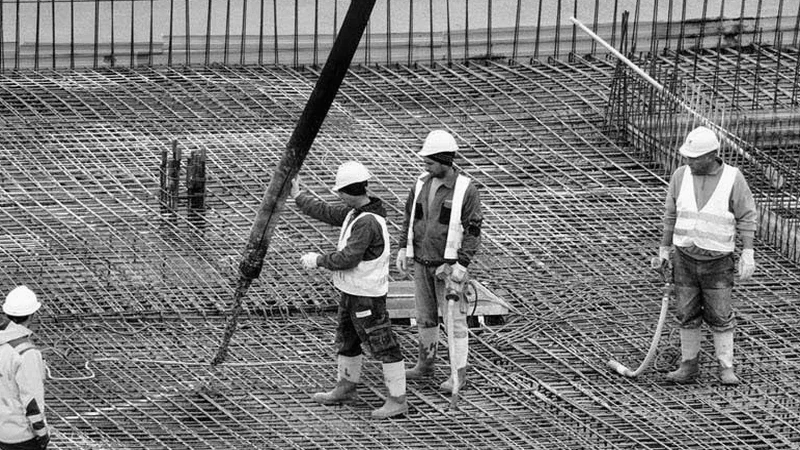
Site-specific factors
In Kingston, we frequently encounter basement excavations that expose the contact between stiff upper till and soft lower clay, a horizon that becomes a shear plane under eccentric loading if the raft is not keyed or deepened locally. The risk compounds in the city's older neighbourhoods like Sydenham Ward, where adjacent heritage structures on rubble stone footings are sensitive to vibration and lateral displacement. A mat foundation designed without considering construction-phase dewatering can experience softening of the subgrade at the excavation base, reducing the design bearing capacity by 30% or more before the concrete is even poured. Our lab insists on pre-pour proof rolling and density testing using the sand cone method to verify that the prepared subgrade meets the compaction specification, because a single soft spot under a raft slab concentrates flexural stresses in ways that simplified uniform-soil models cannot predict.
Regulatory framework
NBCC 2020 (National Building Code of Canada), CSA A23.3:19 (Design of Concrete Structures), Ontario Building Code (OBC) Part 9 — Housing and Small Buildings, ASTM D1194 / D1196 (Plate Load Test — reference for subgrade modulus), CSA S6:19 (Canadian Highway Bridge Design Code — for raft-supported abutments)
Related services
Geotechnical Investigation for Raft Design
SPT drilling and Shelby tube sampling through Kingston's overburden to determine stratigraphy, strength parameters, and consolidation characteristics required for settlement analysis under mat loading.
Modulus of Subgrade Reaction Testing
Field plate load tests or SPT-N to kv correlation, providing the spring stiffness input for finite element raft models; critical for sites with interbedded till and clay lenses.
Structural Raft Analysis and Detailing
FEM slab design under CSA A23.3, including punching shear checks at columns, flexural reinforcement layout, and construction joint detailing for large-pour mats.
Construction-Phase Subgrade Verification
Proof rolling observation, nuclear gauge density testing, and visual inspection of the bearing surface before steel placement, with documented sign-off for building permit compliance.
Typical parameters
Common questions
At what point does a raft foundation become more economical than deep piles in Kingston?
When competent bedrock lies deeper than 6 to 8 metres and the intermediate soil profile consists of stiff to very stiff glacial till, a raft foundation typically costs 30 to 50 percent less than a piled solution. The crossover point depends on column spacing and total building load, but for most mid-rise structures in Kingston's central area, the mat foundation eliminates the mobilization and testing costs associated with driven piles or caissons.
How do you account for Kingston's frost action in raft foundation design?
We specify a minimum underside-of-raft depth of 1.2 metres below exterior grade, which is the frost penetration depth prescribed in the Ontario Building Code for the Kingston area. For heated buildings, the interior portion of the raft benefits from thermal protection, but the perimeter must still be insulated or deepened. We detail rigid insulation extending 600 mm horizontally from the slab edge where the raft sits higher due to grade constraints.
What is the typical cost range for raft foundation design services in Kingston?
Professional fees for a complete raft foundation design package, including geotechnical investigation, laboratory testing, and structural analysis, typically range from CA$1,620 to CA$5,370 depending on building footprint size, number of boreholes required, and complexity of the soil profile. A straightforward single-family residential mat design on known till falls at the lower end; a multi-storey commercial raft requiring consolidation testing and iterative FEM analysis falls at the higher end.
Can a raft foundation be designed for a building addition that ties into an existing basement?
Yes, but it requires careful detailing at the interface. We analyze the existing foundation's settlement history and stiffness, then design the new raft portion with a construction joint that permits limited differential movement while maintaining waterproofing continuity. For Kingston's older masonry buildings, we often specify a dowelled connection with compressible filler at the joint to prevent stress concentration on the existing wall.
What laboratory tests do you run to support raft foundation design parameters?
The testing program typically includes grain size distribution and Atterberg limits to classify the till and clay units, one-dimensional consolidation tests on Shelby tube samples to determine compression index and preconsolidation pressure, and unconfined compression or triaxial tests for undrained shear strength. For projects near the waterfront where the clay may be slightly organic, we add moisture content and loss-on-ignition testing to quantify organic content and assess long-term creep potential.