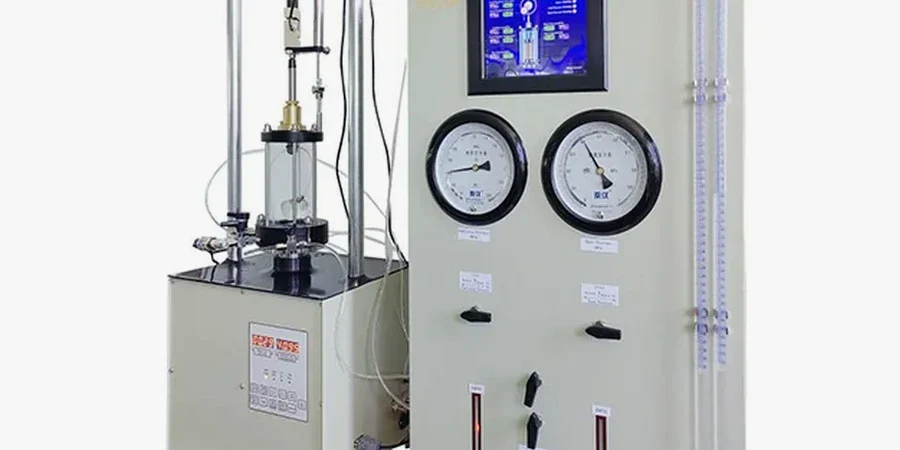
When the triaxial cell is pressurized inside our Kingston lab, the first thing you hear is the quiet hiss of the confining fluid surrounding a carefully trimmed specimen of local limestone or glacial till. It’s a deliberate process—unlike simpler index tests, the triaxial platform lets us isolate pore-water pressure from total stress, which matters enormously in a city where the water table sits just a few metres below the surface across the Cataraqui River basin. We run both consolidated-undrained (CU) and consolidated-drained (CD) stages, building Mohr–Coulomb envelopes that give the design team a reliable pair of numbers: effective cohesion c' and effective friction angle φ'. For projects near the Rideau Canal or on the reactive silts east of Division Street, those parameters often make the difference between a footing that performs and one that tilts after the first freeze–thaw cycle. The equipment we deploy follows ASTM D4767 and D7181 protocols, with back-pressure saturation to achieve Skempton’s B-values above 0.95 before shear begins—a prerequisite for meaningful effective stress paths in low-permeability materials.
A drained triaxial test on Kingston’s laminated clay can reveal an effective friction angle 8–12° lower than undrained quick estimates—that gap drives foundation geometry decisions.
Our approach and scope
Site-specific factors
We were brought in midway through a six-storey residential build on Princess Street where the original investigation had relied solely on unconfined compression tests. The site straddled a pocket of laminated clay that looked stiff in a Shelby tube but softened dramatically under the deviatoric load of a CD triaxial stage—φ' dropped from an assumed 28° to just 19° once the pore pressure dissipated. The structural engineer had already sized the footings, and that 9° delta forced a complete redesign with wider strips and an under-slab drainage blanket. In Kingston’s post-glacial terrain, thin seams of Leda clay are notorious for hiding between limestone bedrock highs; without a triaxial program that captures drained behavior, you’re designing against a fiction. When the schedule is tight, skipping the effective-stress envelope can trigger differential settlement that shows up as stair-step cracking in the first winter, and remediation costs three times what the lab program would have cost. That’s why we insist on at least three CU or CD specimens per distinct stratigraphic unit, so the Mohr–Coulomb fit has statistical weight and the geotechnical report stands up to peer review by the municipality’s external reviewer.
Regulatory framework
ASTM D4767 – Consolidated-Undrained Triaxial Compression Test, ASTM D7181 – Consolidated-Drained Triaxial Compression Test, CSA A23.3 – Design of Concrete Structures (references shear strength for foundations), NBCC 2020 – National Building Code of Canada (geotechnical input requirements)
Related services
Consolidated-Undrained (CU) Triaxial Suite
Three-stage CU program with pore-pressure measurement, ideal for low-permeability Kingston clays where construction loading is faster than drainage. Includes B-check, saturation ramp, and consolidation monitoring before shear.
Consolidated-Drained (CD) Triaxial Suite
Drained shear strength determination for free-draining limestone fill and sandy till, run at slow strain rates to maintain zero excess pore pressure. Delivers the effective friction angle used in long-term bearing capacity and slope stability analyses.
Typical parameters
Common questions
Why can’t we just use unconfined compressive strength instead of triaxial data for footing design in Kingston?
Unconfined compression gives you a total-stress number with no pore-pressure control, which is misleading in saturated Kingston clay where effective stress governs long-term behavior. A CU triaxial test separates the drained friction component from the undrained cohesion, so the structural engineer can size footings for the real drained strength—not an artificially high quick-loading value that disappears once the clay consolidates.
What sample quality do you need for a reliable triaxial test?
We require Shelby tube samples with minimal disturbance—ideally recovered with a piston sampler in soft clay or triple-tube core barrels in weathered limestone. The specimen is hand-trimmed in a humid room to preserve natural moisture, and we reject any tube showing evidence of swelling, cracking, or drilling mud infiltration before extrusion.
How much does a full triaxial testing program cost for a typical Kingston project?
A standard three-specimen CU suite with pore-pressure instrumentation typically runs between CA$2,720 and CA$3,310, depending on the number of confining stress levels and whether we run companion index tests like Atterberg limits. Multi-unit CD suites or programs requiring strain-rate sensitivity studies are scoped separately and quoted after reviewing the borehole logs.
How do you handle the transition between limestone bedrock and overlying clay in the triaxial program?
We treat each unit as a separate test series: the clay gets CU stages with slow strain rates and high back-pressure saturation, while the limestone rock core is tested as an intact rock triaxial specimen with strain gauges if needed. The interface itself is characterized through the borehole log and, where critical, we recommend a cpt-test to capture the continuous strength profile across the contact zone.