Kingston sits on a geological boundary where flat-lying Paleozoic limestone meets the undulating terrain of the Canadian Shield, creating slope conditions that shift dramatically within a single project site. The city’s 44.3054° latitude means freeze-thaw cycles penetrate 1.2 metres into the weathered rock each winter, and spring meltwater saturates the overburden of silty clay till that mantles the escarpment. This combination of fractured limestone bedrock and seasonally saturated colluvium demands a slope stability methodology that goes beyond textbook parameters. Our team combines borehole logging with SPT sampling to define the bedrock surface and overburden strength, then applies Spencer’s method within limit equilibrium frameworks calibrated to the local stratigraphy encountered at sites from Cataraqui Woods to the waterfront bluffs.
In Kingston’s escarpment terrain, a slope that stood for a century can fail during the first spring after a cut alters the groundwater flow path—understanding that lag is essential.
Our approach and scope
Site-specific factors
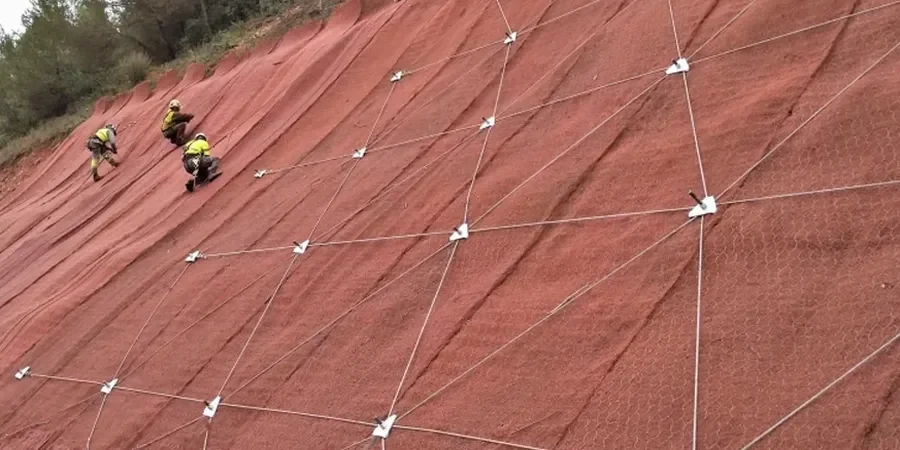
A medium-rise residential project on a former industrial lot near the Inner Harbour ran into trouble when the shoring contractor encountered a clay-filled paleochannel that did not appear on the desktop geological maps. The 7-metre cut excavated for the underground parking triggered progressive slumping in the adjacent slope, cracking the asphalt of a city road just 14 metres from the crest. Our team mobilized within four hours, installed slope inclinometers to track the shear zone, and back-analyzed the failure using the measured displacement rates to calibrate the residual strength parameters of the clay fill. The remedy involved regrading the upper bench to a 2.5:1 inclination and installing a row of permanent soil nails through the shear plane, a design that held through two complete freeze-thaw cycles without measurable movement. That case illustrates why Kingston’s buried valleys—remnants of post-glacial drainage—require a slope design that accounts for the worst material you cannot see at the surface.
Watch the video
Regulatory framework
NBCC 2020 (National Building Code of Canada) seismic hazard provisions, CSA A23.3:2019 Annex R – Geotechnical requirements for foundations and earthworks, ASTM D6467 – Torsional ring shear test for residual strength of soils
Related services
Permanent Slope Design for Development Cut and Fill
We design engineered slopes for residential subdivisions and commercial lots on Kingston’s escarpment lands, producing drawings sealed by a Professional Engineer licensed in Ontario. The design package includes static and pseudo-static stability calculations, drainage provisions to prevent pore pressure buildup, and erosion protection specifications for the silty till that is prone to gullying under concentrated runoff.
Temporary Excavation Slope and Bench Design
For deep excavations in downtown Kingston where space is constrained by adjacent heritage buildings, we prepare temporary slope configurations that comply with OHSA Regulation 213/91 for construction projects. The analysis includes staged excavation sequencing, monitoring trigger levels based on inclinometer and survey data, and contingency plans for encountering the fractured shale layers that underlie the limestone in the city center.
Typical parameters
Common questions
What triggers a slope failure in Kingston’s geology?
Three factors dominate locally: elevated pore water pressure during the March-April thaw when the frozen ground prevents drainage, erosion at the toe from stream undercutting along Cataraqui River tributaries, and stress relief from excavation at the slope base. The weathered limestone caprock also contains solution-enlarged joints that can act as pre-existing failure planes if the dip direction is unfavorable relative to the slope face.
How much does a slope stability analysis cost for a residential lot in Kingston?
For a typical single-lot assessment involving a field investigation, laboratory testing of one or two Shelby tube samples, and a limit equilibrium analysis with a sealed report, the fee ranges from CA$1,800 to CA$5,060 depending on slope height, access constraints, and whether bedrock coring is required.
Do you need to drill boreholes for every slope analysis?
Almost always. Desktop studies based on surficial geology maps cannot capture the local variability in till thickness, bedrock fracture spacing, or the presence of sensitive clay lenses that control the failure mechanism. A minimum of one borehole at the slope crest and one at the mid-height bench is standard practice, with deeper holes where the failure surface is expected to daylight below the toe.
What software do you use for the calculations?
We work primarily with GeoStudio SLOPE/W and RocScience Slide2 for limit equilibrium analyses, and RS2 for finite element stress-deformation modeling when we need to assess progressive failure or the interaction between a slope and a nearby structure. All models are verified against hand calculations using the stability charts published by Bishop and Morgenstern, a practice our senior reviewers require before any report leaves the office.