Kingston sits on a shallow limestone plain where the Paleozoic bedrock often lies within three to five metres of the surface, yet the overburden tells a more complicated story. Glacial till, discontinuous lacustrine clay lenses, and pockets of historical fill from the city’s 19th-century waterfront expansion create abrupt vertical changes that boreholes alone can miss. An exploratory test pit strips away that ambiguity: the open excavation lets the geotechnical engineer walk the profile, measure bedding contacts directly, and collect undisturbed block samples from the strata that govern footing bearing capacity. When the 2019 Rideau River floodplain study exposed soft organic silts beneath granular working platforms in several downtown blocks, contractors began pairing test pits with CPT testing to verify the lateral extent of those compressible layers before committing to excavation support designs.
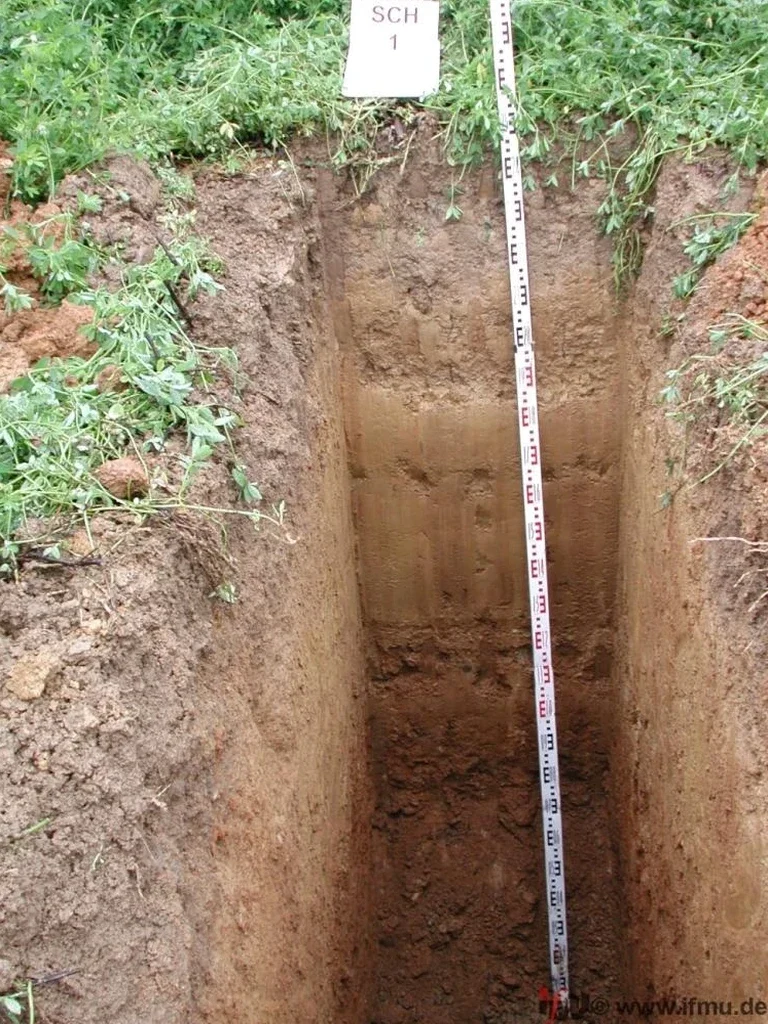
An open test pit transforms a two-dimensional borehole log into a three-dimensional geological model the entire project team can stand inside.
Our approach and scope
Site-specific factors
The most common mistake on Kingston infill lots is treating the entire site as uniform competent till because one borehole encountered dense sand at a metre of depth. An exploratory test pit often uncovers isolated garbage dumps, decayed tree stumps, or uncompacted utility trench backfill that occupies less than ten percent of the footprint but aligns precisely with the proposed footing line. Leaving those soft spots undetected leads to differential settlement within the first two freeze-thaw cycles, cracking brick veneer and distorting window frames. The Ontario Building Code requires identification of deleterious fill, and a visual pit inspection remains the fastest path to compliance. On larger commercial projects near the Cataraqui River, pits also reveal the depth of desiccated crust over soft clay—critical for designing the floating slab thickness.
Watch the video
Regulatory framework
CSA A23.3: Design of Concrete Structures (foundation exposure assessment), NBCC 2015 Part 4: Structural Design (geotechnical site investigation requirements), Ontario Regulation 406/19: Excess Soil Management, ASTM D2487: Classification of Soils for Engineering Purposes (Unified Soil Classification System), ASTM D1557: Standard Test Methods for Laboratory Compaction Characteristics of Soil Using Modified Effort
Related services
Site Stratigraphy Mapping
Direct measurement of layer thicknesses, contact attitudes, and lateral continuity across multiple pits to build a reliable ground model for foundation design and earthworks quantification.
In-Situ Sampling from Pits
Collection of undisturbed block samples and bulk disturbed samples from identified units for laboratory strength, consolidation, and grain-size testing under the laboratory’s ISO 17025 accredited program.
Typical parameters
Common questions
How much does an exploratory test pit cost in Kingston?
For a single pit excavated to four metres in typical Kingston till with standard logging and photographic documentation, the cost usually falls between CA$620 and CA$1,060. The final figure depends on access constraints, the need for traffic control permits on city streets, and whether laboratory testing is added to the scope.
What is the difference between a test pit and a borehole?
A test pit is an open excavation that exposes a continuous face of soil and rock, letting the engineer see fabric, colour mottling, and structural features directly. A borehole provides a discontinuous sample recovered from a narrow diameter hole. Pits excel at finding thin weak layers and mapping lateral transitions, while boreholes reach depths that pits cannot.
Do you need a permit to dig a test pit in Kingston?
Most private residential and commercial sites require only a locate request for buried utilities before excavation. A road occupancy permit is necessary if the pit encroaches on the municipal right-of-way. For sites within the Cataraqui Region Conservation Authority regulated area near watercourses, additional approval may apply.
How long does a test pit stay open?
A typical pit is open for one to three hours while logging and sampling take place, then backfilled immediately. In rare cases where extended observation is needed—such as monitoring groundwater inflow rates—the pit is fenced with site-specific fall protection and left open for a maximum of 24 hours under continuous supervision.