We run the borehole log first. In Kingston, a truck-mounted CME-75 auger sinks through the fractured Gull River limestone until refusal around 12 to 18 meters. That refusal is what drives the excavation design. You cannot guess bedrock depth here—the Paleozoic limestone undulates sharply, and a 15-meter cut on Princess Street will hit different horizons than one two blocks north near the Cataraqui River. We pair the auger refusal data with CPT testing to map the soft silty clay lenses trapped in the glacial till, because those pockets control the lateral earth pressure distribution. Once we have the stratigraphy pinned, we run finite element models under NBCC 2015 Part 4 loads, checking cantilever deflection, strut preload loss, and the ratio of passive resistance to active thrust at every lift.
Kingston limestone does not behave like Toronto shale. If your design assumes constant K₀, you are already behind the failure curve.
Our approach and scope
Site-specific factors
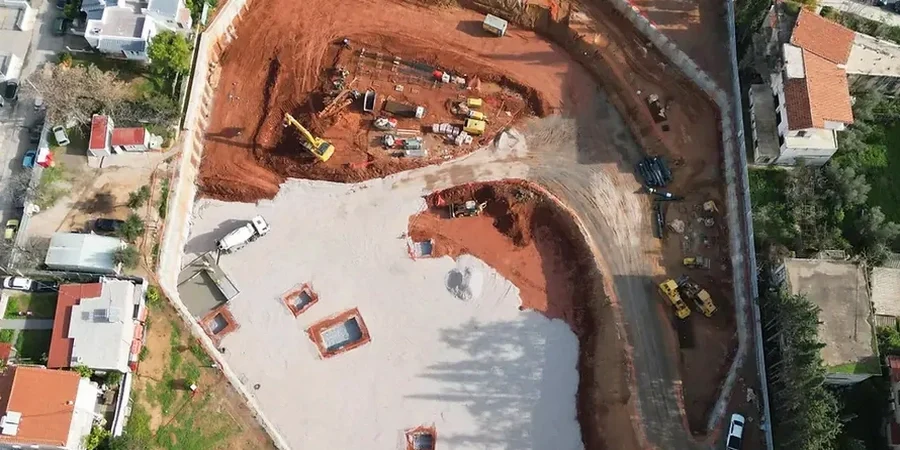
Kingston sits at 44.3054° N on the boundary between the Frontenac Arch and the St. Lawrence Lowlands, where the seismicity is moderate but real—the 2013 magnitude 5.2 quake near Ladysmith reminded everyone that the Western Quebec Seismic Zone reaches this far. A deep excavation in water-bearing fractured limestone faces two failure modes that shallow footings never see: piping erosion through open joints during a 100-year rain event, and a sudden loss of passive resistance if the rock socket is too shallow. We design the dewatering system for a permeability contrast of three orders of magnitude between the till (10⁻⁶ cm/s) and the limestone (10⁻³ cm/s in open joints). The sump pumps must handle 400 L/min minimum if we intersect a karst conduit. Every soldier pile socket length is verified against the CSA A23.3 bond stress limits, and we specify vibration monitoring with a 12.5 mm/s PPV threshold on nearby heritage masonry—because Kingston's limestone downtown has stood since 1840 and nobody wants to be the engineer who cracked City Hall.
Regulatory framework
NBCC 2015 (National Building Code of Canada, Part 4), CSA A23.3-14 (Design of Concrete Structures), CSA S6-14 (Canadian Highway Bridge Design Code – earth retention sections), ASTM D4395 (Pressuremeter Testing in Rock), MTO Excavation Support Guidelines (applicable provincial supplement)
Related services
Shoring Wall Design
Soldier pile and lagging, secant pile, or diaphragm wall design with deflection predictions under staged excavation. We include the effect of locked-in rock stress from pressuremeter data.
Dewatering and Groundwater Control
Design of deep well systems, sump capacity, and cutoff walls. We model the dual-porosity flow regime of fractured limestone and overlying till using MODFLOW-USG.
Strut and Tieback Analysis
Preload specification, thermal load compensation, and wedge failure analysis at the tieback bond zone in limestone. All designs checked against CSA S6-14.
Construction-Phase Monitoring
Inclinometer arrays, load cells on struts, and vibration monitoring with PPV thresholds calibrated to nearby heritage structures. Weekly stability review reports.
Typical parameters
Common questions
How deep can we excavate next to an existing building in downtown Kingston without underpinning?
It depends on the building's foundation depth and the rock profile. Under NBCC 2015, the zone of influence extends at a 1:1 line downward from the adjacent footing. If the excavation toe stays outside that envelope and the rock socket provides sufficient passive resistance, we can often reach 12 meters without underpinning. We confirm this with a soil-structure interaction model using actual pressuremeter K₀ values.
What is the cost range for a geotechnical design of a deep excavation in Kingston?
A complete design package—including site investigation review, shoring design, dewatering plan, and construction monitoring specifications—typically ranges from CA$2,700 to CA$9,740 depending on excavation depth, proximity to adjacent structures, and the complexity of the groundwater regime. This covers the stamped engineering drawings and calculations required for a City of Kingston building permit.
How do you handle the fractured limestone when calculating passive resistance at the toe?
We run pressuremeter tests in each borehole to measure the in-situ modulus and limit pressure of the rock mass. The passive resistance is calculated using the Hoek-Brown failure criterion with a GSI (Geological Strength Index) derived from core logging and RQD. We never use intact rock properties alone—that overestimates capacity and can lead to a toe kick-out failure.
What instrumentation is required during excavation near heritage buildings?
For excavations within 30 meters of a designated heritage structure, the City of Kingston typically requires inclinometers behind the wall, optical survey points on the adjacent building facade, and vibration monitors set to a 12.5 mm/s PPV alarm threshold. We specify the monitoring frequency and trigger levels in the design package and review the data weekly.
Do you need a hydrogeological study for dewatering a deep excavation in Kingston?
Yes, if the excavation extends more than 2 meters below the seasonal high groundwater table, the Ministry of the Environment, Conservation and Parks requires a Permit to Take Water. We conduct a pumping test to determine the hydraulic conductivity of the limestone and till, then design the dewatering system to meet the permit's discharge quality and drawdown limits.