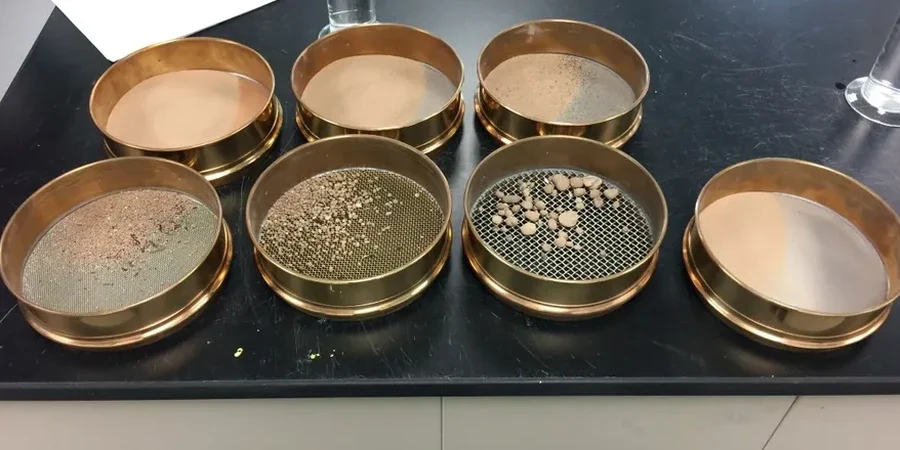
Kingston sits on a complex glacial legacy where the limestone bedrock of the Ordovician period meets thick deposits of till, glaciolacustrine clay, and nearshore sand. The Cataraqui River and Little Cataraqui Creek corridors add layers of soft organic silt and alluvium that can ruin a grading plan if not properly characterized. In our experience, the first step to untangling this stratigraphy is a precise grain size analysis that captures the full range of particles, from gravel down to the clay fraction. A combined sieve and hydrometer test per ASTM D422 tells us whether a lean clay from the west end will hold a footing or whether a silty sand from the CFB Kingston area needs drainage correction. We run these curves routinely for consultants across Frontenac County, tying the grain size distribution directly to the Unified Soil Classification System so that every foundation, retaining wall, and pavement design starts with real numbers, not assumptions.
A single grain size curve can reveal whether a soil will drain, heave, or densify under the cyclic loading that Kingston's frost and traffic impose each year.
Our approach and scope
Site-specific factors
The biggest pitfall we observe in Kingston is misclassifying a gap-graded glacial till as a well-graded sand because the lab skipped the hydrometer step. A till from the Portsmouth district might show 40 percent gravel and 35 percent sand on the sieves, but the remaining 25 percent silt and clay completely controls the drained strength and the susceptibility to frost heave. If that fine fraction is missed, the pavement design will underestimate the subgrade's capillary rise, and the foundation may be sized for a cohesionless material that does not actually exist. Another risk is running the hydrometer without proper deflocculation; the calcium carbonate from the local limestone bedrock can cement fine particles together, giving a false coarse reading. We use sodium hexametaphosphate and extended mixing to break those bonds and get a true clay fraction, which is critical for structures that must meet the seismic provisions of the 2020 National Building Code of Canada.
Regulatory framework
ASTM D422-63(2007) – Standard Test Method for Particle-Size Analysis of Soils, ASTM D6913/D6913M-17 – Sieve Analysis of Soils, ASTM D7928-17 – Hydrometer Analysis for Particle-Size Distribution, ASTM D2487-17 – Unified Soil Classification System, OPSS 1010 – Ontario Provincial Standard Specification for Granular Materials, NBCC 2020 – National Building Code of Canada (seismic site class)
Related services
Complete Soil Classification Package
Combines sieve and hydrometer grain size with Atterberg limits, moisture content, and specific gravity to deliver a complete USCS classification per ASTM D2487. Ideal for foundation reports, shoring design, and subdivision grading plans across Kingston's variable till and clay terrain.
Field Density and Gradation Control
We pair the lab grain size curve with sand cone density tests or nuclear gauge readings on-site. This lets contractors near Bath Road or Highway 15 verify that the placed fill meets the specified gradation band and compaction target, layer by layer.
Typical parameters
Common questions
How much does a combined sieve and hydrometer grain size test cost in Kingston?
For standard projects in the Kingston area, a combined sieve and hydrometer analysis typically falls between CA$120 and CA$250 per sample, depending on the number of sieves requested, the presence of oversized particles, and whether rush reporting is needed. We provide a firm quote after reviewing the sample condition and the project specification.
How long does the hydrometer test take, and why can't it be rushed?
The hydrometer phase follows a strict sedimentation schedule with readings at 1, 2, 5, 15, 30, 60, 240, and 1440 minutes, per ASTM D422. The 24-hour reading is mandatory to capture the clay fraction below 2 microns. We can expedite the sieve portion and the report writing, but the sedimentation time is fixed by physics. Most reports leave our lab within three to five business days.
Do I need the hydrometer if my soil is mostly sand and gravel?
If the material passing the No. 200 sieve exceeds 5 percent by dry mass, we strongly recommend the hydrometer. Even a small amount of silt or clay can significantly change permeability, frost heave potential, and the seismic site class under the 2020 National Building Code. For granular subbase under OPSS 1010, knowing the exact fines content is what determines compliance.
What sample size do you need for a grain size analysis in Kingston?
For fine-grained soils like the Leda clay found in parts of Kingston, we need a minimum of 500 grams of dry material. For granular soils with gravel, we require at least 5 kilograms to obtain a representative split. If you are sampling from a drill rig or test pit, please seal the bag immediately to preserve the natural moisture content, as we will report it alongside the grain size curve.