Kingston sits on a karst landscape—Ordovician limestone with solution channels and variable bedrock depth that standard boreholes miss. At a recent project near the Rideau Canal, the bedrock surface dropped 4 meters across 20 meters of site frontage, invisible from surface inspection. Vertical Electrical Sounding (VES) maps these transitions without invasive drilling. We run Schlumberger arrays with AB/2 spacings out to 100 meters, pulling apparent resistivity curves that resolve limestone bedrock, overburden thickness, and water-filled cavities. For sites within the Cataraqui River watershed, where groundwater interaction determines excavation method, combining VES data with an in-situ permeability program gives the full hydrogeological picture before shovels hit ground.
On Kingston limestone, VES resolves cavity depth to within 10% when verified by borehole—accuracy that ground-penetrating radar cannot deliver in conductive clay overburden.
Our approach and scope
Site-specific factors
Kingston's population of roughly 135,000 continues to grow along the Highway 401 corridor, pushing development onto marginal land near Collins Bay and the Little Cataraqui Creek floodplain. Unknown cavity depth is the cost driver here—drilling into a solution channel at 6 meters where VES would have flagged low resistivity at 4 meters turns a straightforward foundation into an over-excavation and grouting operation. In 2023, a commercial project east of the Cataraqui River lost three weeks to redesign after encountering an unmapped karst feature. That delay was entirely avoidable. VES costs a fraction of a borehole and covers the whole footprint, not just a point. On sites with historical fill or former industrial use, resistivity anomalies also highlight contaminant plumes that Ontario Regulation 153/04 requires you to characterize before submission.
Regulatory framework
NBCC 2020 (National Building Code of Canada, Section 4.2 – Foundations), CSA A23.3 (Design of Concrete Structures, geotechnical input requirements), ASTM D6431 (Standard Guide for Using the DC Resistivity Method), Ontario Regulation 903 (Wells – groundwater investigation standards)
Related services
VES Survey Design & Execution
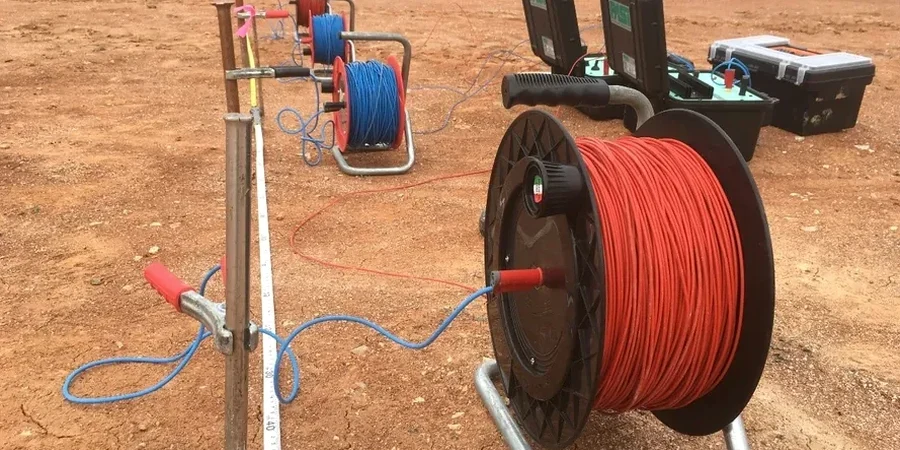
Schlumberger array layout with AB/2 spacing tailored to target depth. We stake and survey electrode positions, run stacked readings, and flag noise sources in real time.
1D Resistivity Inversion & Interpretation
Smooth and layered inversions with topography correction. Deliverables include apparent resistivity curves, interpreted layer thicknesses, and depth-to-bedrock maps.
Karst & Cavity Detection
Targeted VES grids for mapping solution channels, voids, and fracture zones in Kingston's Ordovician limestone. Cross-validated with water well and borehole records.
Combined Geophysical & Geotechnical Integration
We coordinate VES results with SPT drilling, test pitting, and permeability testing to produce a unified ground model for foundation and excavation design.
Typical parameters
Common questions
What depth can VES reach in Kingston's limestone geology?
With a maximum AB/2 spacing of 100 meters and Kingston's typical overburden resistivity (30–100 Ω·m), effective investigation depth ranges from 25 to 35 meters. The limestone bedrock at 150–800 Ω·m provides strong resistivity contrast, giving clear layer boundaries in the interpreted model.
How much does a VES survey cost for a typical Kingston residential lot?
For a standard single-family lot in Kingston, a VES survey with 4–6 sounding points and a 1D inversion report typically runs CA$960 to CA$1,260. The range depends on access conditions, number of soundings, and whether we integrate with existing borehole or well log data.
Can VES replace boreholes for foundation design?
No—VES provides continuous subsurface profiling but cannot measure strength or collect samples. We recommend VES as a screening tool to optimize borehole locations. In Kingston's karst terrain, combining resistivity with targeted SPT drilling gives the most reliable ground model for NBCC-compliant foundation design.
Does winter weather affect VES readings in Kingston?
Frozen ground increases contact resistance at surface electrodes, but we mitigate this with salt-water saturated electrode pads and higher injection voltages (up to 800 V). Winter surveys run reliably from November through March as long as snow cover does not exceed 30 cm—we simply clear electrode positions and extend contact time.