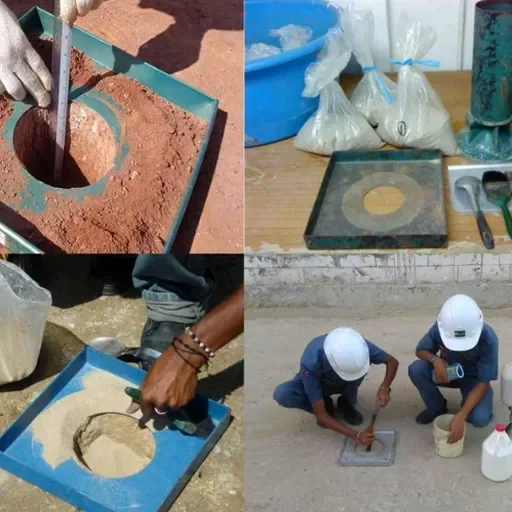
Compaction specifications in Ontario are governed by OPSS.MUNI 206 and verified through strict ASTM D1556 protocols, a requirement that takes on particular weight in Kingston where the overburden consists of dense glacial till and glaciolacustrine silty clays draped across a Paleozoic limestone basement. The sand cone method remains the most direct, defensible field check for engineered fill beneath footings, slab-on-grade, and utility trench backfill because it measures in-place density in a single undisturbed volume—no nuclear gauge corrections, no calibration against a laboratory proctor that was run on a different material. Our team runs these tests daily on residential subdivisions near Collins Bay, commercial pads off Gardiners Road, and institutional expansions at Queen’s University, where the contrast between native till and imported granular fill demands a density benchmark that holds up under the third-party review cycle that Ontario municipalities enforce as standard practice. In a city that sits on the boundary of the Frontenac Arch’s shallow bedrock and the deeper drift of the St. Lawrence lowlands, a number that looks good on paper means nothing if the test location and depth interval were chosen without understanding the site’s Quaternary stratigraphy.
A sand cone density test takes twenty minutes to run properly; a single failed compaction lift that goes undocumented until the footing inspection can set a project back two weeks while the engineer re-evaluates bearing capacity.
Our approach and scope
Site-specific factors
Kingston’s built fabric expanded rapidly through the 1960s and 1970s when subdivisions pushed north into terrain that straddles the contact between shallow limestone pavement and compressible lacustrine clay basins—a legacy that shows up today as differential settlement in older slab-on-grade construction and recurring compaction disputes on redevelopment sites where existing fill of unknown provenance underlies the new engineered pad. The sand cone test becomes the single piece of physical evidence that separates a defensible compaction record from an assumption, because it captures density at a discrete point and depth without the averaging or moisture interference that can mask a loose pocket in a mixed fill. When the native soil is a stiff till that compacts beautifully at two percent below optimum but turns to rock flour when over-rolled wet, the difference between 98% and 93% is often a single afternoon of rain—and in Kingston’s humid continental climate, with lake-effect precipitation off Lake Ontario arriving with little warning, that moisture spike can hit a grading operation faster than a nuclear gauge can be pulled off the charger. We treat every density test as a point on a curve that the contractor needs to see in real time, not as a pass/fail stamp delivered days later when the lift is already buried under a metre of subsequent fill.
Watch the video
Regulatory framework
ASTM D1556-15e1: Standard Test Method for Density and Unit Weight of Soil in Place by Sand-Cone Method, ASTM D698-12(2021): Standard Test Methods for Laboratory Compaction Characteristics of Soil Using Standard Effort, OPSS.MUNI 206: Construction Specification for Grading, NBCC 2020 Division B Part 4: Structural Design (referenced for foundation bearing requirements), CSA A23.3-19: Design of Concrete Structures (referenced for slab-on-grade compaction prerequisites)
Related services
In-Place Density by Sand Cone (ASTM D1556)
Direct measurement of wet density and dry density on compacted lifts in building pads, road subgrade, and utility trenches, with moisture content determined by laboratory oven-drying of the excavated material.
Compaction Curve Development (ASTM D698/D1557)
Standard and Modified Proctor tests on project-specific borrow sources to establish the target dry density and optimum moisture content before field compaction begins.
Nuclear Gauge Correlation Studies
Site-specific calibration of nuclear density gauges against sand cone results to account for local soil chemistry and moisture variability, reducing systematic bias in production testing.
Compaction Verification Reports for Municipal Submission
Complete test location plans, summary tables, and statistical analysis formatted to meet City of Kingston and MTO acceptance requirements for subdivision and infrastructure projects.
Typical parameters
Common questions
How much does a field density test with the sand cone method cost in Kingston?
For projects within the Kingston area, a single sand cone density test including field measurement plus laboratory moisture content determination typically falls in the range of CA$160 to CA$210, depending on site access conditions and the total number of tests scheduled on the same day. Mobilization to sites outside the urban core—for example, toward Joyceville or Inverary—is quoted separately based on distance and the number of test locations.
How many sand cone tests does the City of Kingston require for a residential foundation pad?
The City of Kingston generally follows OPSS.MUNI 206 guidelines, which specify a minimum of one test per 200 square metres per compacted lift, with at least three tests per lift regardless of pad size. For a typical single-family home pad of 100–150 m², that translates to three tests per lift across at least three lifts, totaling nine or more density measurements before the footing inspection is called.
What is the difference between the sand cone test and a nuclear density gauge?
The sand cone method (ASTM D1556) excavates a small volume of soil, weighs it, measures the hole volume with calibrated sand, and determines moisture content by oven-drying—it gives a direct, primary density measurement with no calibration dependency on the local soil chemistry. A nuclear gauge infers density from gamma radiation attenuation and moisture from neutron moderation; it reads faster but can drift several percent in Kingston’s glacial till due to naturally elevated equivalent uranium in the mineral fraction derived from the Canadian Shield. Both have their place, but when a compaction dispute arises, the sand cone is the referee method.
Can you test density in crushed limestone fill, like the material from local Kingston quarries?
Yes, the sand cone method works well in crushed limestone fill from local sources such as the Gull River Formation quarries north of the city, provided the maximum particle size does not exceed 50 mm. For fills with larger stone, we adapt the test volume per ASTM D5030 or use a water-replacement method on oversized particles removed from the excavation. More info.