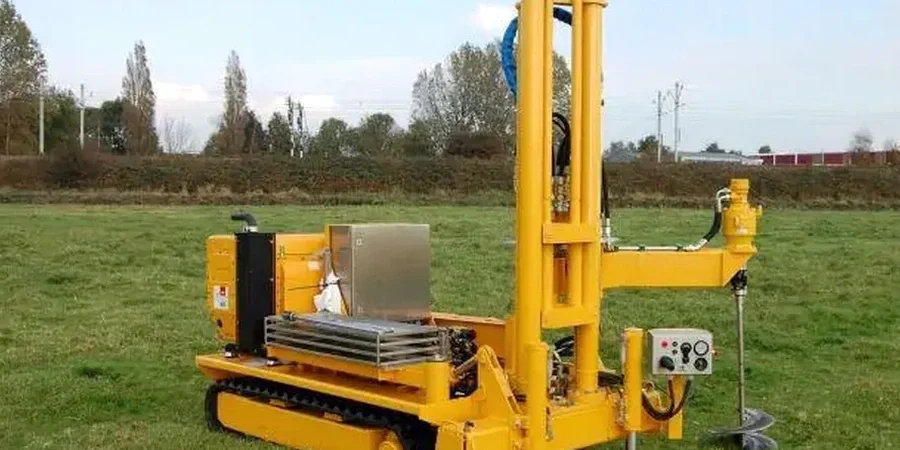
Kingston sits on a tricky transition zone. The Ordovician limestone of the Cataraqui River basin is close to surface in the west end, but east of the Cataraqui River the overconsolidated glacial till and Leda clay layers run deep and unpredictable. We have probed sites where competent limestone bedrock vanishes within 30 lateral meters, replaced by a soft silty clay lens that a standard borehole could misread. For this geology, we deploy our CPT test rig with a 20-tonne push capacity—enough to refusal on the Gull River Formation. The cone captures tip resistance, sleeve friction, and pore pressure in one continuous push. That profile is what Kingston engineers need before setting footing elevations or planning a deep excavation near the inner harbour. In low-lying areas south of Bath Road, where the water table sits barely 1.5 m down, we combine CPT data with in-situ permeability measurements to give the full picture on drainage and uplift risk.
A single CPT push in Kingston’s east-end clays can distinguish five distinct stratigraphic units before hitting limestone refusal — resolution no SPT split spoon can match.
Our approach and scope
Site-specific factors
The NBCC 2020 and CSA A23.3 set clear requirements for site investigation, and in Kingston the consequence of a sparse investigation is amplified by the buried rock surface variability. We have reviewed projects where a single borehole suggested uniform limestone at 8 meters, yet CPT probes 15 meters away hit refusal at 18 meters inside a soft clay trough. A foundation designed for the 8-meter assumption would experience differential settlement severe enough to crack masonry within the first two freeze-thaw cycles. The Leda clay present in pockets east of the Cataraqui is also sensitive — remolding during excavation can drop its undrained shear strength by more than 50%. Our CPT data feeds directly into soil behavior type charts using normalized parameters, flagging sensitive clays before a backhoe ever breaks ground. For seismic design under NBCC, the cone’s continuous shear wave velocity profile (when we run a seismic CPT) identifies the soft soil sites that amplify ground motion along the Frontenac Axis.
Regulatory framework
NBCC 2020 — National Building Code of Canada, CSA A23.3 — Design of Concrete Structures (foundation requirements), ASTM D5778 — Standard Test Method for Electronic Friction Cone and Piezocone Penetration Testing, ASTM D7400 — Standard Test Methods for Downhole Seismic Testing (when SCPT is performed)
Related services
CPTu Stratigraphic Profiling
We run a piezocone with pore pressure measurement at the u2 position, producing continuous logs of corrected tip resistance, friction ratio, and pore pressure. The data is processed with soil behavior type charts to map lithology across the site.
Pore Pressure Dissipation Testing
At preselected depths we stop the cone and record pore pressure decay over time. The dissipation curve yields the coefficient of consolidation, which feeds directly into settlement rate calculations for the silty clay layers common in Kingston.
Seismic CPT (SCPT)
A geophone module behind the cone captures shear wave arrivals from a surface hammer source. The resulting Vs profile is used for NBCC site class determination and liquefaction assessment in the sandier units near the lake.
CPT-to-Borehole Correlation
We pair CPT soundings with a limited number of boreholes and lab testing. The cone data interpolates between boreholes, and the borehole samples calibrate the cone’s soil behavior type interpretation to Kingston’s specific till and limestone geology.
Typical parameters
Common questions
How deep can you push the cone in Kingston’s limestone terrain?
It depends on the overburden and the rock surface. In the west end near the Cataraqui escarpment, refusal often arrives between 6 and 10 meters when the cone hits the Gull River limestone. East of the river, where glacial till and clay are thicker, we routinely reach 18 to 22 meters before refusal. We stop the test when the tip stress approaches 100 MPa or the sleeve friction spikes, indicating competent rock.
What does a CPT cost for a residential lot in Kingston?
For a single-family residential lot with one or two soundings, you are generally looking at CA$200 to CA$340 per sounding, depending on depth and whether you need dissipation tests or seismic shear wave measurements. Mobilization to Kingston and basic reporting is included in that range, but sites with difficult access or extra testing requirements will adjust the final figure.
Do you need to drill a borehole alongside the CPT?
Not always, but we recommend at least one borehole for soil sampling and lab index testing when the CPT will be used for foundation design. The borehole provides ground truth for the cone’s soil behavior type interpretation. In Kingston’s mixed fill and till, a single calibration borehole can anchor CPT data from ten or more soundings across the site.
Can CPT detect the sensitive Leda clay we hear about in eastern Ontario?
Yes, and that is one of its strengths. Sensitive clays show a characteristic combination of low tip resistance, very low sleeve friction, and elevated pore pressure during penetration. The friction ratio and normalized soil behavior type chart flag these zones clearly. When we see that signature in Kingston’s east-side deposits, we alert the design team before any excavation starts, because remolding can cause a rapid strength loss.