A 6-storey mixed-use development near Princess Street hit limestone pinnacles at 4 metres. The excavation support had to switch from a conventional soldier pile system to a tied-back anchor solution in less than a week. That is Kingston geology.
The Ordovician limestone bedrock here is notoriously irregular, capped by dense glacial till and occasionally pockets of soft Leda clay near the Cataraqui River. Designing an active/passive anchor system in these conditions means you are not just calculating bond length. You are mapping karst features, measuring fracture spacing, and verifying that your grout-to-ground bond survives the 1-in-2,475-year seismic event mandated by the NBCC for eastern Ontario. We pair our anchor designs with a CPT test to profile the overburden continuously before selecting the bond zone elevation.
A properly designed anchor in Kingston limestone should transfer load at least 3 metres into competent rock. Anything less is gambling with the bond.
Our approach and scope
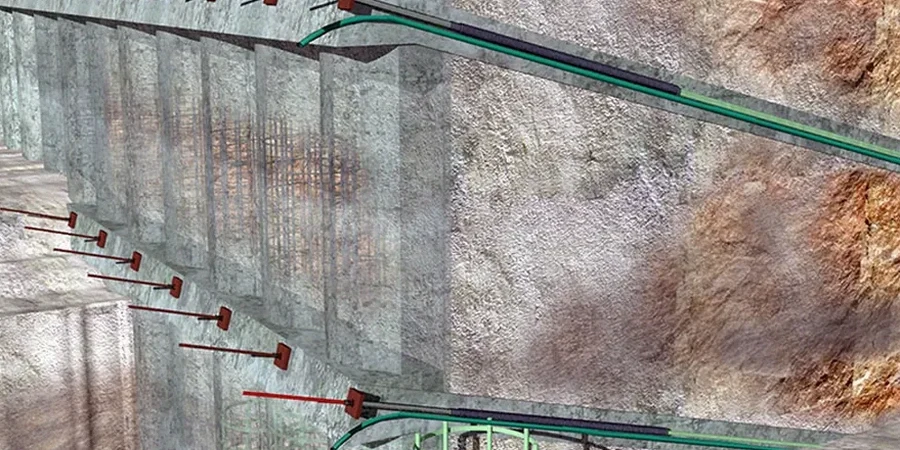
A passive anchor in a permanent retaining wall on Queen's University campus behaves very differently from a temporary active anchor on a Highway 401 widening. Our design approach differentiates them from the outset: active anchors are pre-stressed to 80% of the tendon yield strength and locked off immediately, while passive anchors mobilize resistance only after the wall deflects. Both require corrosion protection Class II per CSA A23.3 in Kingston's de-icing salt environment. The bond length in limestone is verified against FHWA GEC No. 4 guidelines, and we often specify water-pressure testing in the bond zone when karst voids are suspected. For deep excavations near heritage buildings, we integrate excavation monitoring with the anchor installation sequence to limit lateral movement to under 10 mm.
Site-specific factors
A hydraulic hollow-stem jack rated for 1,500 kN sits on a reaction frame bolted to a limestone face near the LaSalle Causeway. The pressure gauge ticks upward in 50 kN increments. At 880 kN, the dial hesitates. That hesitation—a 2 mm creep over 10 minutes—is a telltale sign of bond degradation in fractured rock.
If you ignore that creep and lock off the anchor, you have installed a time bomb. Residual load in the anchor will bleed off over the next 48 hours as the grout column micro-cracks, and the wall will begin to deflect. In a passive anchor system, the consequence is progressive deformation. In an active system, you lose pre-stress and the entire wall load redistributes to the remaining anchors, potentially overloading them. Kingston's limestone contains vugs and clay-filled seams that are invisible from the surface. Every anchor we design includes a sacrificial investigation anchor on 30-metre centres, tested to 150% of the working load before production drilling begins.
Watch the video
Regulatory framework
CSA A23.3-19 (Design of Concrete Structures – Anchorage provisions), NBCC 2020 (Seismic hazard for Kingston: Sa(0.2) = 0.39g), CAN/CSA-S6-19 (Canadian Highway Bridge Design Code – Ground anchor provisions), PTI DC35.1-14 (Post-Tensioning Institute Recommendations for Prestressed Rock and Soil Anchors), FHWA GEC No. 4 (Ground Anchors and Anchored Systems – bond length in rock)
Related services
Active Anchor Design for Deep Excavations
Pre-stressed strand anchors designed to limit lateral wall movement in Kingston's urban core. Includes bond length verification in limestone, tendon free length calculation, and staged lock-off sequence integrated with the excavation schedule.
Passive Tieback and Soil Nail Systems
Reaction anchors and grouted bars for temporary and permanent retaining structures in glacial till overburden. Design accounts for long-term creep in the till and seasonal groundwater fluctuation near the Cataraqui River.
Anchor Testing and Verification
Proof testing, performance testing, and extended creep testing per PTI and CSA protocols. We use hydraulic jacks with digital load cells and LVDTs to capture load-displacement behaviour with 0.01 mm resolution.
Typical parameters
Common questions
What is the difference between an active and a passive ground anchor?
An active anchor is tensioned to a specified lock-off load immediately after grout curing, applying a pre-compressive force to the structure before any soil movement occurs. A passive anchor is installed without initial tension; it mobilizes resistance only when the retained soil mass begins to deflect and loads the anchor through movement. In Kingston practice, active anchors are standard for permanent tied-back walls where deformation must be controlled to under 10 mm, while passive anchors are common in temporary excavations or soil nail walls where controlled movement is acceptable.
How do you determine the bond length in Kingston limestone?
Bond length is calculated based on the unconfined compressive strength of the limestone and the grout-to-rock interface friction, typically 500 kPa to 1,000 kPa for competent Kingston Formation limestone. We verify the design with water-pressure testing in the bond zone to detect karst voids or clay-filled seams, and we require a sacrificial investigation anchor tested to 150% of working load before production drilling. Minimum bond length is 3.0 metres in competent rock, but can exceed 6.0 metres in fractured zones near the Cataraqui River.
What is the typical cost range for anchor design in Kingston?
Anchor design fees for Kingston projects typically range from CA$1,480 to CA$5,380 depending on the number of anchor rows, the complexity of the geological profile, and the testing program required. A simple temporary passive anchor system with 20 anchors at a single level falls toward the lower end. A multi-row active anchor system for a permanent 8-metre excavation with proof testing, extended creep tests, and corrosion protection detailing falls toward the upper end.
Does the NBCC seismic requirement affect anchor design in Kingston?
Yes, and significantly. Kingston's seismic hazard is higher than many assume for eastern Ontario, with a spectral acceleration Sa(0.2) = 0.39g on Site Class C per NBCC 2020. Anchor design must account for the seismic increment in lateral earth pressure, which can increase the anchor load by 25% to 40% compared to static conditions. We apply the Mononobe-Okabe pseudo-static method to compute the seismic earth pressure coefficient and verify that the anchor free length extends beyond the critical failure surface under seismic loading.
What corrosion protection is required for permanent anchors in Kingston?
Permanent anchors in Kingston require Class II corrosion protection per CSA A23.3, which means the tendon is fully encapsulated in a corrugated plastic sheathing with grout filling the annular space between the strand and the sheath. This is non-negotiable in Kingston due to the widespread use of de-icing salts on roads, which elevates chloride levels in the groundwater near any excavation adjacent to a roadway. The anchorage head at the bearing plate is also encapsulated in a grease-filled cap. Temporary anchors with a service life under 24 months may use Class I protection with a reduced grout cover.