Kingston sits at the eastern end of Lake Ontario, where the city's limestone bedrock is often masked by deep deposits of glacial till and post-glacial lake sediments. This geology matters more than most realize when seismic events—though infrequent in the region—can trigger a sudden loss of soil strength in saturated granular layers. The 2010 Central Canada earthquake, felt strongly in Kingston, reminded the local engineering community that even moderate shaking can reveal hidden instability in loose, water-charged soils. A rigorous soil liquefaction analysis examines the interplay between groundwater conditions, grain-size distribution, and anticipated ground acceleration to quantify the factor of safety against this phenomenon. Our geotechnical team combines decades of regional fieldwork with laboratory testing calibrated to the specific stratigraphy found beneath Kingston's historic downtown core and newer suburban expansions. For complex sites near the Cataraqui River, we often integrate the analysis with a seismic microzonation study to map varying risk levels across a single property, while the CPT test provides continuous pore-pressure and tip-resistance data essential for the assessment.
Loose saturated sands that look stable under static load can lose over 80% of their bearing capacity in less than 10 seconds of seismic shaking—a risk that Kingston's glacial deposits hide well.
Our approach and scope
Site-specific factors
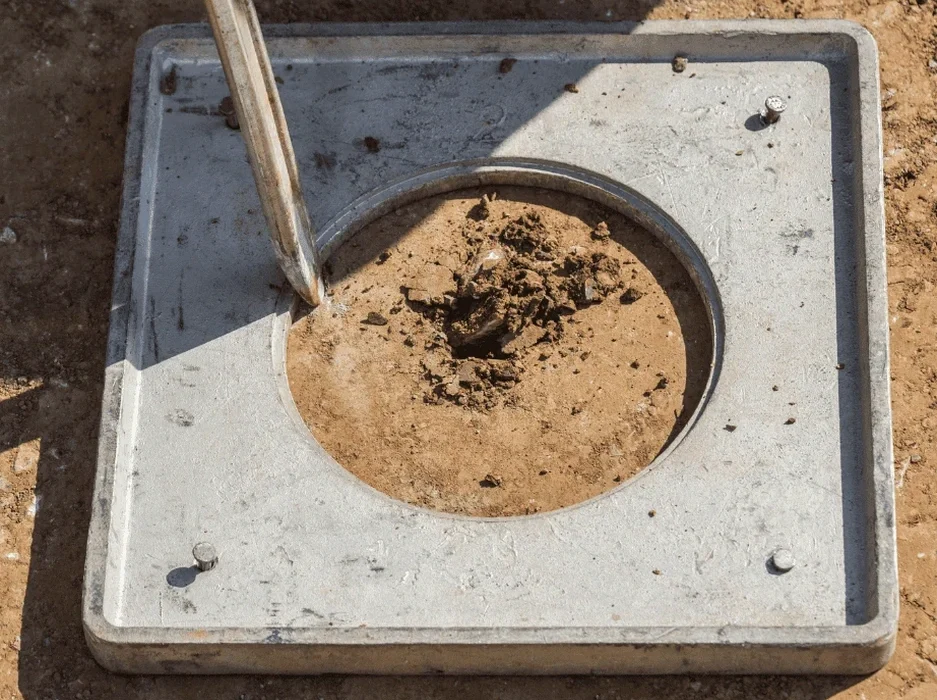
The CPT rig we mobilize for Kingston projects is a 20-tonne truck-mounted unit with electronic friction-sleeve and pore-pressure transducers that push a 10 cm² cone at a controlled 2 cm/s rate through the soil profile. This equipment generates a near-continuous record of tip resistance, sleeve friction, and equilibrium pore pressure—data that feeds directly into the cyclic stress ratio calculations for the soil liquefaction analysis. What the CPT reveals in Kingston's north-end subdivisions is often a 3- to 5-metre-thick layer of loose fine sand sitting just above the water table, a configuration that scores high on the liquefaction potential index when combined with the NBCC spectral acceleration for a 2,475-year return period event. The risk is not theoretical: we have documented artesian conditions in several boreholes near the Little Cataraqui Creek floodplain, where upward hydraulic gradients keep granular layers in a perpetually near-liquefied state. Without a site-specific analysis that accounts for these local hydrogeologic anomalies, a foundation design based on textbook bearing-capacity assumptions could underestimate settlement by an order of magnitude under seismic loading.
Regulatory framework
NBCC 2020 (National Building Code of Canada, Division B, Part 4), CSA A23.3-14 (Design of Concrete Structures), ASTM D5311/D5311M-13 (Standard Test Method for Load Controlled Cyclic Triaxial Strength of Soil), ASTM D1586 (Standard Test Method for Standard Penetration Test), Ontario Building Code O. Reg. 332/12 as amended
Related services
Liquefaction Screening & Factor of Safety Calculation
We apply the simplified procedure using corrected SPT N-values or CPT tip resistance to calculate the cyclic resistance ratio for each soil layer, comparing it against the seismic demand from the NBCC 2020 ground-motion models. The output includes a layer-by-layer factor of safety and a liquefaction potential index map for the site.
Post-Liquefaction Settlement and Lateral Spreading Assessment
Where the analysis confirms liquefiable layers, we estimate volumetric strain and reconsolidation settlement using the Ishihara and Yoshimine method, and evaluate the potential for lateral spreading toward the Cataraqui River or adjacent watercourses using Newmark-type displacement analysis calibrated to Kingston's subsurface geometry.
Ground Improvement Design for Liquefaction Mitigation
For sites where the factor of safety falls below the regulatory threshold, we prepare performance-based ground improvement specifications—typically vibrocompaction or stone columns—and provide construction-phase verification testing including post-treatment CPT to confirm that the target density and drainage conditions have been achieved.
Typical parameters
Common questions
What is the typical cost of a soil liquefaction analysis for a single-family home lot in Kingston?
For a standard residential lot within the Kingston city limits, a complete soil liquefaction analysis—including two to three CPT soundings, laboratory grain-size testing on selected samples, and the engineering report with factor of safety calculations—generally ranges from CA$3,220 to CA$5,850. The final cost depends on site access constraints, groundwater monitoring requirements, and whether the initial screening indicates the need for cyclic triaxial testing on undisturbed samples.
Is liquefaction really a concern in Kingston considering it is not a high-seismicity zone?
Kingston sits in a moderate seismic hazard region under NBCC 2020, with a 2% probability of exceedance in 50 years for ground shaking that can trigger liquefaction in susceptible soils. The city's glacial lake deposits contain extensive layers of loose, saturated fine sand that are precisely the type of material most vulnerable to strength loss during even moderate shaking. We have measured in-situ conditions in north Kingston where the factor of safety against liquefaction drops below 1.0 under the design earthquake, making it a genuine and documented concern for any project on these soils.
How long does a liquefaction analysis take from field work to final report delivery?
A typical timeline for a Kingston project runs four to five weeks: one week for mobilizing the CPT rig and completing the field investigation, two weeks for laboratory testing including grain-size and Atterberg limits, and one to two weeks for the senior geotechnical engineer to perform the analysis, run the numerical settlement calculations, and prepare the stamped report. Expedited schedules can be arranged when construction timelines are tight, though the laboratory curing and testing cycles set a practical minimum of approximately three weeks.