The Ordovician limestone that underlies much of Kingston, with overburden depths fluctuating between zero and ten meters of glacial till, creates a geotechnical profile where bearing capacity can shift dramatically within a single building footprint. Our shallow foundation design work here consistently encounters the contact between competent bedrock and loose silty sand left by the Champlain Sea transgression, a transition that demands careful interpretation of subsurface data before any footing geometry is finalized. When the limestone is shallow, we often specify a bearing pressure of 150 to 300 kPa, but the presence of solution-worn cavities and pinnacles in the Gull River Formation introduces a risk that only a combination of test pits and targeted CPT testing can properly delineate. Kingston’s seasonal frost penetration, which the Ontario Building Code sets at 1.2 meters, further governs the minimum embedment depth for exterior footings and compels us to consider frost-protected shallow foundation alternatives where site grades make deep excavation impractical.
In Kingston, a footing bearing on limestone with karstic features can lose half its design capacity within a metre horizontally—continuous site characterization is not optional.
Our approach and scope
Site-specific factors
We have seen too many Kingston projects where the geotechnical report was treated as a permit checkbox and the foundation was poured without verifying the actual bearing surface at each excavation bottom. The city’s limestone geology is famous for its pinnacled rockhead—a condition where sharp ridges of sound rock alternate with troughs of compressible residual clay, and a rigid footing bridging across two pinnacles can crack at mid-span from the differential stiffness alone. On a site east of the Little Cataraqui Creek, we once reviewed a design where the assumed uniform rock profile from three boreholes missed a two-metre-deep clay pocket that would have settled 40 mm under the column load; the fix required deepening four pad footings by 1.8 metres and adding a mud slab to span the soft zone. Karstic dissolution features, while less dramatic than in the Bruce Peninsula, do appear in Kingston’s Gull River and Bobcaygeon formations, and we routinely specify probe drilling or resistivity surveying ahead of finalizing shallow foundation layout when the site history or neighbouring well records suggest potential voids.
Regulatory framework
NBCC 2015 (National Building Code of Canada, Part 4), CSA A23.3-14 (Design of Concrete Structures), CSA S6:19 (Canadian Highway Bridge Design Code, Section 6), ASTM D1194 / D1195 (Plate Load Test — bearing capacity verification), Ontario Building Code O. Reg. 332/12 (frost protection and footing depth), CFEM (Canadian Foundation Engineering Manual, 4th Edition)
Related services
Spread Footing Design for Residential and Light Commercial
Complete bearing capacity and settlement analysis for isolated and strip footings on glacial till or bedrock, including frost protection detailing, drainage specifications, and reinforcement design per CSA A23.3. Typically delivered for single-family homes, townhouse blocks, and low-rise commercial structures across Kingston.
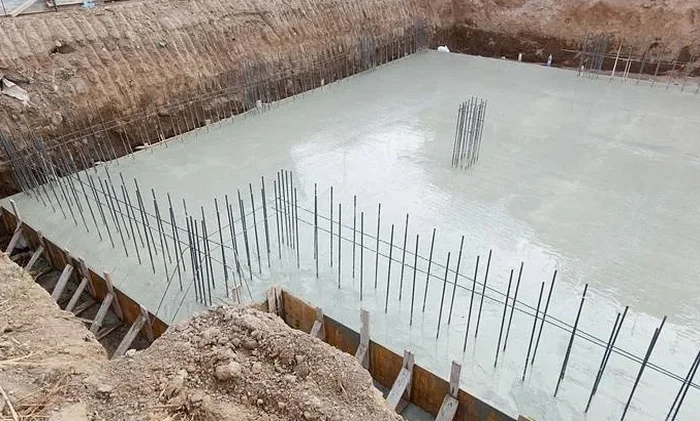
Mat Foundation Design for Sensitive or Variable Ground
Full soil-structure interaction modeling for raft foundations where variable limestone depth or compressible till pockets rule out individual footings. Includes subgrade reaction modulus calibration from field testing, structural design of the mat slab, and construction-stage monitoring recommendations.
Forensic Review and Remedial Design for Existing Footings
Investigation and redesign of underperforming shallow foundations exhibiting excessive settlement or cracking in Kingston's older building stock. We combine historic drawing review, new subsurface investigation, and analytical modeling to develop underpinning or slab-jacking remediation strategies.
Typical parameters
Common questions
How much does shallow foundation design cost for a typical Kingston residential project?
For a single-family home or small commercial building in Kingston, shallow foundation design services generally range from CA$2,380 to CA$4,040 depending on the complexity of the ground conditions and the number of footing types required. A straightforward site on dense till with a confirmed bearing stratum may fall at the lower end, while a site with variable rock depth, karst concerns, or the need for a mat foundation solution will trend toward the upper end. The fee covers geotechnical interpretation, bearing capacity and settlement calculations, reinforcement detailing, and a sealed design package suitable for building permit submission under the Ontario Building Code.
What is the minimum footing depth required by the Ontario Building Code in Kingston?
The Ontario Building Code (O. Reg. 332/12) mandates a minimum footing depth of 1.2 metres below finished grade for heated buildings in the Kingston area to place the bearing surface below the design frost penetration line. For unheated structures, or where the foundation is exposed to exterior air on one side, that depth increases to at least 1.5 metres. There are exceptions for frost-protected shallow foundations that use rigid insulation to modify the thermal regime beneath the slab, but those require a site-specific design sealed by a professional engineer and must demonstrate that the subgrade temperature will remain above freezing under the 50-year return-period cold event.
Can you design shallow foundations on Kingston's limestone without deep boreholes?
It depends on the variability of the site, but in most parts of Kingston we strongly recommend at least some rotary or percussion drilling to confirm rock quality and detect potential karstic features that test pits alone might miss. The Gull River Formation limestone can present solution-enlarged joints and occasional small cavities, and a footing placed over a thin rock bridge could fail progressively. We typically combine a limited number of boreholes with test pits at each footing location and, where justified, a resistivity survey to screen for anomalies between the investigation points. The goal is to verify continuous competent rock or till across every loaded area, not just to assume uniformity from a few widely spaced data points.